How much does custom software cost for a small business?
Written by Mitch Crevier and Aarush Bhardwaj
7 min read
TL;DR
Custom software built by a development company usually costs a small business tens of thousands of dollars. In GoodFirms' 2026 survey of development companies, about two thirds of custom projects cost $30,000 to $100,000 and took three to six months. The price is driven by scope, integrations with tools like QuickBooks, moving existing data, and the maintenance that follows launch. Many small businesses do not need a custom system at all: they need a few small apps on top of the tools they already pay for, which can now be built from a plain description.
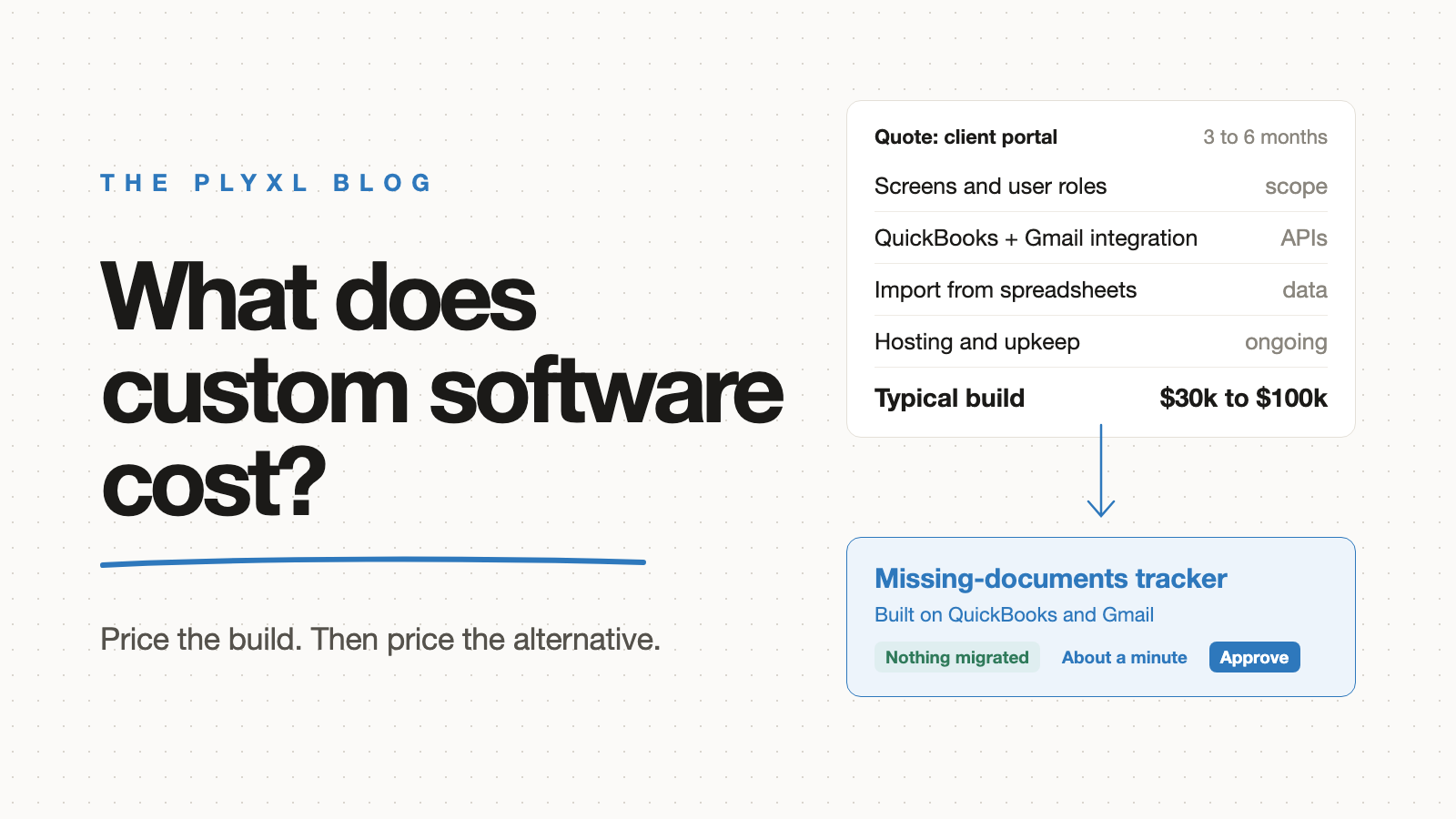
Custom software built by a development company usually costs a small business tens of thousands of dollars and takes months. In GoodFirms' 2026 survey of development companies, about two thirds of custom projects cost $30,000 to $100,000 and took three to six months. Most small businesses asking this question do not need a whole custom system, though. They need a few small apps on top of the tools they already pay for, and those can now be built from a plain description.
Below is what a custom software project costs, what drives the price, how the options compare, and when a full custom build is actually worth it.
How much does custom software cost for a small business?
Custom software for a small business typically costs tens of thousands of dollars when a development company builds it. GoodFirms' 2026 custom software development cost survey, which asked software development companies about their projects, found that about two thirds of custom projects cost $30,000 to $100,000 and took three to six months to deliver.
Those figures describe the build only. They leave out the owner's time on requirements and testing, and the cost of keeping the software running afterward. A quote well below that range usually means a smaller scope or a single freelancer; well above it usually means many user roles, several integrations, or a data migration.
What drives the cost of custom software?
The cost of custom software is driven mainly by scope, integrations, data, and maintenance. Each one adds developer hours, and developer hours are what a quote is made of.
- Scope. Every screen, user role, and rule adds work. "A job tracker" for one office manager is a different project from a job tracker with technician logins, customer notifications, and a manager dashboard.
- Integrations. Connecting to QuickBooks, Xero, Gmail, or Stripe means working with each tool's API, handling sign-in, and keeping up when the vendor changes something. Each integration is its own small project.
- Moving existing data. Importing years of customers or jobs from spreadsheets means cleaning the data first. That work is often underestimated because nobody knows how messy the data is until someone opens it.
- Who builds it. An agency brings project management and a team. A freelancer brings lower overhead and a single point of failure. An in-house developer brings a salary that continues after the project ends.
- Maintenance after launch. Hosting, security updates, bug fixes, and changes to the business all continue for as long as the software is used. A build quote rarely shows this line.
How do the options for getting custom software compare?
The options for getting software that fits a small business range from hiring a development company to building small apps yourself on top of connected tools. The table compares them on what usually matters to an owner.
| Development agency | Freelancer | In-house developer | No-code builder | Business workspace | |
|---|---|---|---|---|---|
| Upfront cost | Tens of thousands of dollars; most projects $30,000 to $100,000 in GoodFirms' survey | Billed hourly or per project | A full salary, before benefits | A subscription, plus the time to learn the tool | Free plan, no card needed |
| Time to something working | Typically three to six months | Weeks to months, by scope | Hiring time, then the build | Days to weeks of someone's time | About a minute per app, after connecting tools |
| Who maintains it | The agency, under a contract | The freelancer, if available | The developer you employ | Whoever on your team built it | Anyone on the team, in plain language |
| Connects to QuickBooks, Gmail | Built as part of the project | Built as part of the project | Built as part of the project | Through the builder's connectors | Through each tool's own sign-in |
| Where the data lives | A new database you now own | A new database you now own | A new database you now own | Inside the builder | Stays in the tools you already use |
| Best for | Software that is the product you sell | Small, well-defined tools | Businesses with ongoing software needs | Owners who enjoy building | The gaps between your existing tools |
Pricing for the workspace option is on the pricing section. The last row matters more than it looks: software with its own database becomes another system of record to keep in step with QuickBooks and the inbox.
Why is custom software so expensive for a small business?
Custom software is expensive for a small business because one company pays the whole cost of building something that packaged software spreads across thousands of customers. Fred Brooks, the computer scientist who managed IBM's System/360 software, made this point in his 1986 essay No Silver Bullet, where he named buying mass-market software instead of building it as one of the most promising ways to get software at all.
That is also why the processes no product quite fits end up in spreadsheets: they were never worth a custom project on their own. The buy vs build post covers which software to buy and which to build.
What does this look like in practice?
In practice, most small businesses that ask for a custom software quote need one or two small apps, not a new system. Three illustrative examples, each a typical business rather than a specific customer:
- An eight-person bookkeeping firm gets a quote for a custom client portal that tracks documents and sends reminders, including an import of client lists from Excel. Instead, the firm connects QuickBooks Online and Gmail and builds a missing-documents tracker that drafts reminders for staff to approve. Nothing is imported, because the clients already live in QuickBooks.
- A 12-person HVAC company wants a system that knows which finished jobs have not been invoiced, and a developer scopes the Google Calendar and QuickBooks integrations as most of the work. The owner connects both tools and builds a job board that turns a finished job into a draft invoice awaiting approval.
- A landscaping company with two crews considers a freelancer-built quoting tool. The owner keeps the quote spreadsheet, which works, and builds only a request tracker fed by the website form.
In each case the expensive part of the quote, integrations and data migration, disappeared because the app was built on top of the tools instead of beside them. The accounting firm apps post has more examples built on QuickBooks.
When is paying for custom software worth it?
Paying for custom software is worth it when the software is the product the business sells, or when no combination of existing tools can hold the data the business depends on. For everything else, a full custom build means paying to recreate records that already live in QuickBooks, Gmail, or a calendar. Martin Fowler, chief scientist at Thoughtworks, describes the alternative in Strangler Fig Application: add new pieces on top of the existing system and move work over gradually, so the cost and the results arrive step by step. The connect vs migrate post explains why that is usually safer than replacing what works.
How should a small business get software that fits without a custom build?
A small business should start with the one process its team tracks by hand every week and build a small app for only that process, on top of the tools it already uses. Check that those tools are on the connections list, describe the app in a sentence, and see whether it does the job before asking anyone for a quote.
Plyxl is a business workspace: connect the tools your business runs on, then build the software you need on top. Tools connect with one OAuth sign-in, an app is built from a plain description in about a minute, nothing runs without approval, and every action lands in an activity log with undo. The Free plan needs no card, and pricing has the details. Start at plyxl.com and build the app you were about to get a quote for.
Frequently asked questions
How much does custom software cost for a small business?
Usually tens of thousands of dollars when built by a development company. GoodFirms' 2026 survey found about two thirds of custom projects cost $30,000 to $100,000 and took three to six months.
Why do custom software quotes vary so much?
Quotes vary because the price follows scope: the number of screens and user roles, integrations with tools like QuickBooks or Gmail, moving existing data, and who does the work. Two quotes for "a client portal" can describe very different projects.
Is the build price the whole cost of custom software?
No. Custom software also needs hosting, security updates, bug fixes, and changes when the business or a connected tool changes. Ask any developer for the maintenance terms before signing, not after launch.
Is a freelancer cheaper than a development agency?
Often for small, well-defined projects, since a freelancer carries less overhead. The tradeoff is that one person holds all the knowledge of the system, so ask who will maintain it if that person moves on.
What is the cheapest way to get software that fits how my business works?
For most small businesses, build small apps on top of the tools already in use instead of commissioning a new system. In a business workspace like Plyxl, an app is built from a plain description in about a minute, and the Free plan needs no card.